














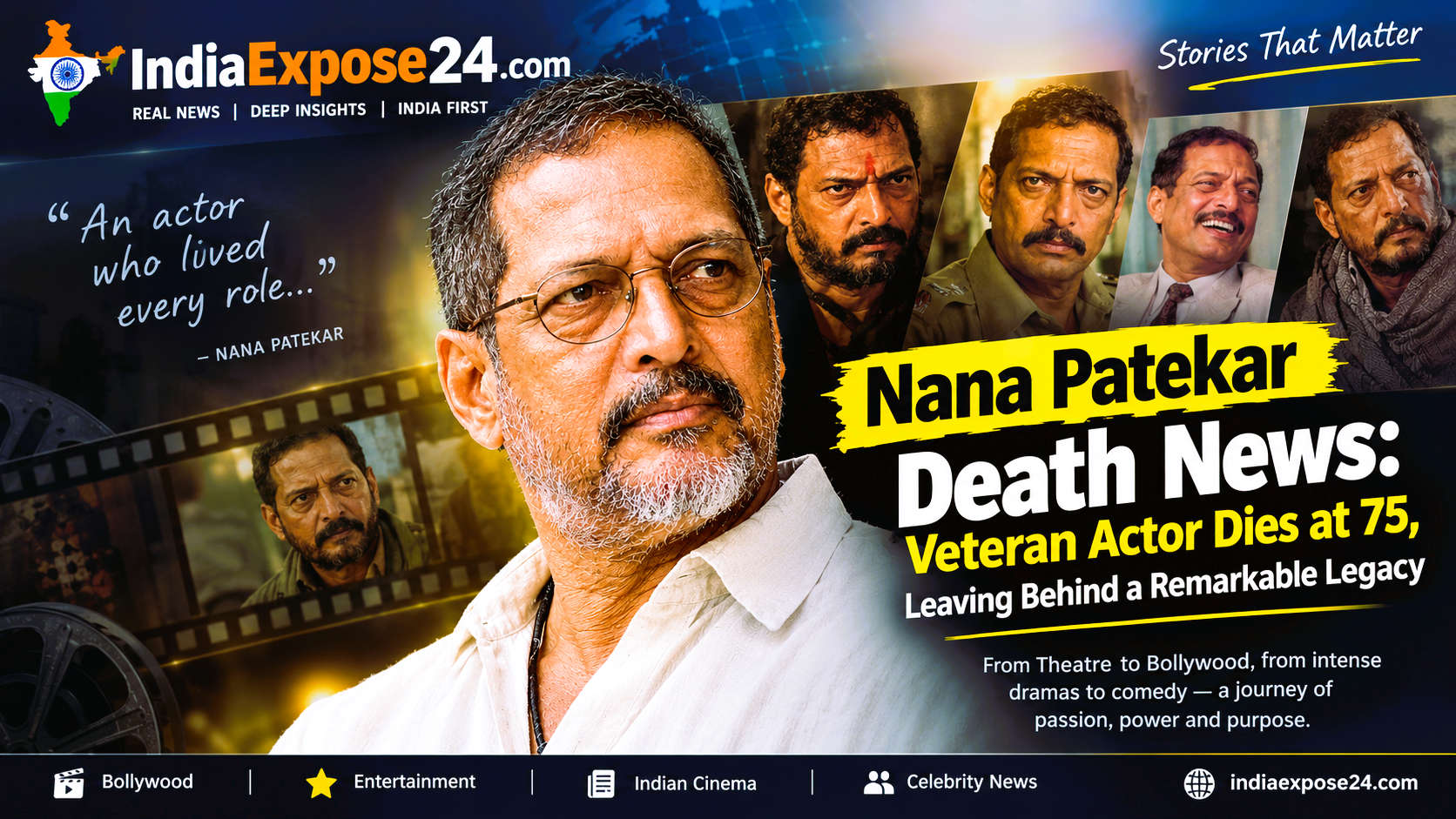
Nana Patekar Death News: Veteran Actor Dies at 75, Leaving Behind a Remarkable Legacy
Nana Patekar Death News: Indian cinema has lost one of its most distinctive and respected performers. Veteran actor and filmmaker Nana Patekar has died at the age of 75, leaving behind a career that spanned more than five decades.
The news of his death has sent shockwaves across the Hindi and Marathi film industries. Fans, fellow actors, filmmakers and public figures have been remembering the actor for his powerful screen presence, distinctive voice and ability to bring extraordinary depth to even the simplest characters.
According to reports, Patekar was at his residence in Goa when his health suddenly deteriorated. He was taken to hospital, but doctors could not save him. Reports have attributed his death to a cardiac arrest.
His passing marks the end of an important chapter in Indian cinema. Few actors managed to move so naturally between intense dramas, socially relevant films, Marathi cinema and mainstream Bollywood entertainment.
Nana Patekar Dies at 75? Is that true or rumors?
Nana Patekar reportedly suffered a medical emergency at his Goa residence. He was subsequently taken to a hospital, where he was declared dead at around 5:20 am, according to reports.
The sudden nature of his death has left fans particularly shocked. Patekar was still associated with films and had continued working despite being in his seventies.
One of his upcoming projects, Shakti Shalini, was among the films that he had worked on before his death. Director Aditya Sarpotdar reportedly said that Patekar had completed filming and was looking forward to seeing the final version of the movie.
For an actor who spent decades in front of the camera, his continued enthusiasm for cinema showed how deeply filmmaking remained connected to his life.
A Career That Began Away From Stardom
Unlike many Bollywood stars who enter the industry through glamorous roles, Nana Patekar built his reputation gradually.
He started his journey through theatre and eventually moved into films. His film career began with Gaman in 1978. Over the years, he developed a reputation for choosing challenging roles rather than simply chasing conventional leading-man characters.
His performances were often intense, unpredictable and emotionally powerful.
Patekar had a rare ability to make audiences believe that they were watching a real person rather than an actor performing a scripted role.
That quality became one of the defining characteristics of his career.
During his long career, Patekar appeared in numerous Hindi and Marathi films.
Some of his most remembered movies include Parinda, Prahaar, Krantiveer, Tirangaa, Agni Sakshi, Welcome, Natsamrat and The Attacks of 26/11.
Each film showed a different side of the actor.
In serious dramas, he was known for his emotional intensity and commanding dialogue delivery. In commercial cinema, he could effortlessly switch to comedy and create memorable moments without losing his distinctive personality.
That versatility helped him remain relevant across different generations of movie audiences.
Krantiveer Made Him a Household Name
One of the most important films in Nana Patekar’s career was Krantiveer.
His performance in the film became one of the defining moments of his career. The character’s anger, frustration and determination were brought to life through Patekar’s powerful acting.
His dialogue delivery became particularly memorable among audiences.
Rather than relying only on dramatic background music or conventional Bollywood heroism, Patekar often allowed his expressions and voice to carry the emotional weight of a scene.
The performance earned him widespread recognition and remains one of the roles for which he is best remembered.
Natsamrat Showed His Emotional Range
Nana Patekar’s Marathi film Natsamrat demonstrated another side of his acting ability.
The film follows an ageing theatre actor dealing with changes in his personal life, relationships and identity after spending much of his life on stage.
Patekar’s performance was deeply emotional and received widespread appreciation.
For many viewers, Natsamrat was a reminder that his acting was not dependent on action, glamour or elaborate production values. His expressions, voice and emotional control were enough to carry an entire film.
He Could Make Audiences Laugh Too
Although Nana Patekar was particularly famous for serious and intense roles, he also proved himself in comedy.
His role in Welcome introduced his performance style to another generation of viewers.
The film’s comic situations allowed Patekar to show a completely different side of his personality. His timing, expressions and dialogue delivery became an important part of the movie’s appeal.
The success of Welcome also demonstrated why it would be difficult to place Patekar into a single category.
He could play a serious revolutionary, a troubled theatre artist, a police officer, a social character or a comic gangster-like figure with equal conviction.
A Multi-Award-Winning Actor
Nana Patekar’s contribution to Indian cinema was recognized through some of the country’s major honours.
He won three National Film Awards during his career and was also awarded the Padma Shri, one of India’s highest civilian honours.
These awards reflected not only his popularity but also the critical recognition he received for his work across different genres and languages.
His career demonstrated that commercial success and serious acting could exist side by side.
His Connection With Theatre
Theatre remained an important part of Nana Patekar’s artistic identity.
His stage background influenced the way he approached film performances. He was known for treating dialogue as an important part of character development rather than simply as lines that had to be delivered.
His voice became one of his most recognizable characteristics.
Even a short scene could become memorable when delivered by Patekar because of his distinctive rhythm, pauses and expressions.
Directors and co-stars often spoke about the intensity he brought to his performances.
Beyond Films: His Social Work
Nana Patekar was also known for his involvement in social causes.
Over the years, he participated in initiatives connected with farmers and people affected by difficult economic conditions. His public image was often different from that of a conventional Bollywood celebrity.
He generally maintained a relatively private lifestyle and was known for speaking openly about social issues.
This connection with ordinary people added another dimension to his public identity.
Tributes Pour In After His Death
Following news of his death, tributes began coming from across India.
Political leaders, actors, filmmakers and fans remembered him as an artist who made a lasting contribution to Indian cinema.
Prime Minister Narendra Modi also expressed condolences, remembering Patekar’s contribution to Hindi and Marathi cinema and his ability to portray memorable characters.
For the film industry, his death represents the loss of an actor whose style could not easily be replicated.
A Legacy That Will Continue
Nana Patekar’s death is a major loss for Indian cinema, but his work will continue to introduce new audiences to his extraordinary talent.
His films crossed generations because the emotions in his performances were not limited to a particular period.
Whether it was the anger of Krantiveer, the emotional pain of Natsamrat, the intensity of Prahaar or the comic energy of Welcome, Patekar repeatedly demonstrated his versatility.
He was not an actor who needed to be constantly visible to remain relevant.
His performances did that work for him.
For millions of viewers, Nana Patekar will remain the voice, face and personality behind some of the most memorable characters in Indian cinema.
His journey from theatre to becoming one of India’s most respected actors is a story of talent, persistence and an uncompromising approach to his craft.
Nana Patekar may have left the world, but his performances will continue to live on through the films he gave Indian cinema.
IndiaExpose24.com pays tribute to the legendary actor and filmmaker.